This post was intended to complete the discussion of indexation databases for the Lublin Voivodeship. But I will write it soon, as a follow-up to the previous one.
PODLASIE
Fulfilling a specific request, in the current entry I will discuss the indexing portal that deals with the Podlasie region. Podlasie is an area east of Masuria and Masovia, and covers most of the current Podlaskie Voivodeship. It was part of the Congress Kingdom in the Russian partition.

The portal I will discuss deals primarily with the genealogy of the Podlaskie and Masovian regions.
https://indeksy.projektpodlasie.pl/
The home page explains the rules for creating the database and using its resources. There is also a map with marked towns included in the project.
A big advantage is the several languages in which the home page is available. This makes it easier to register, which is necessary to have access to the search engines.

Under “Search Tools” there are two search engines:
the first is GENPOD
and the second is Catalog of Metrical Records Book.
Both are only in Polish.
https://genpod.projektpodlasie.pl/
GENPOD is a search engine for surnames in several different databases.
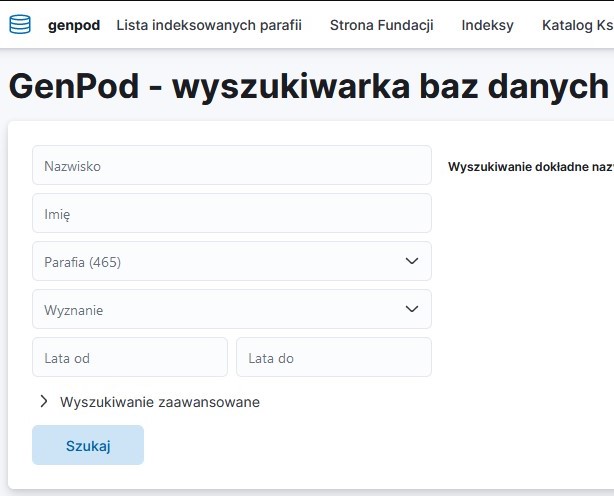
You can enter in the following fields: Surname ( detailed search option is next)
Name
Parish
Confession
Range of years
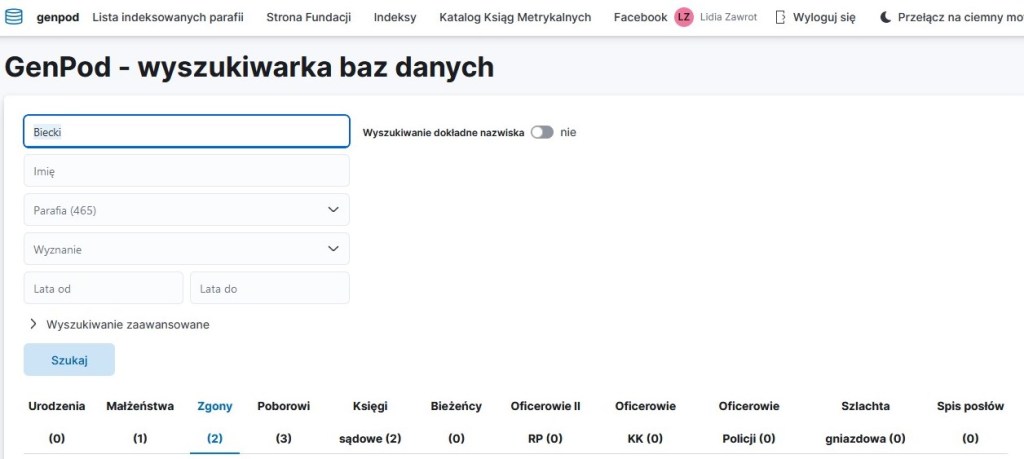
After entering the surname (or part of it), you receive the results of searching in parish indexes, list of conscripts 1862-1866, court books (17th and 18th centuries), the register of the so-called Bieżeńcy1, list of officers of the Congress Kingdom (it means under Russian rule since 1918), lists of officers of the Polish Army of the Second Polish Republic (1919-1939), lists of deputies of the Second Polish Republic (1919-1939), a list of the nest nobility from the times of the First Polish Republic (17th and 18th centuries) and police officers of the Second Polish Republic (1919-1939).
Unfortunately, what seems at first glance to be an advantage of the website, i.e. a large num ber of results, is its weakness.
Too many results require selection. To do this, you need to know the scope and data area of individual databases well.
This can be difficult for many, especially when it comes to the 20th century.
It is best to use a search engine to obtain data from only two databases: indexed record books, and the conscript list.
These are the first 4 columns in the GENPOD results – Births, Marriages, Deaths and Conscripts.
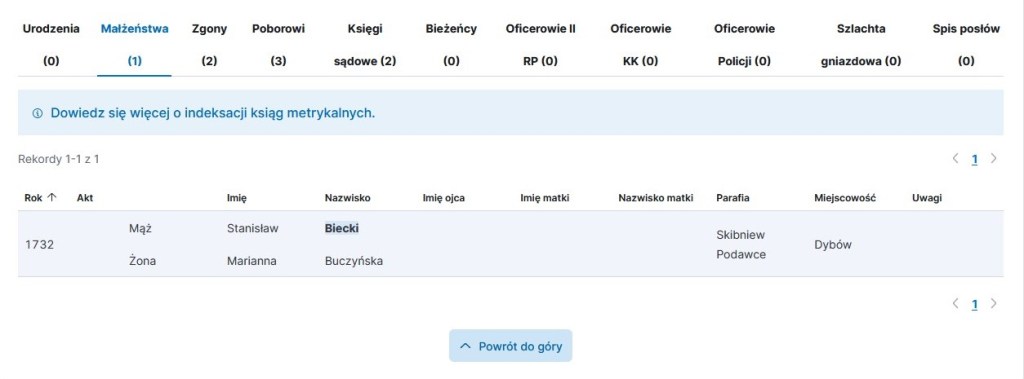
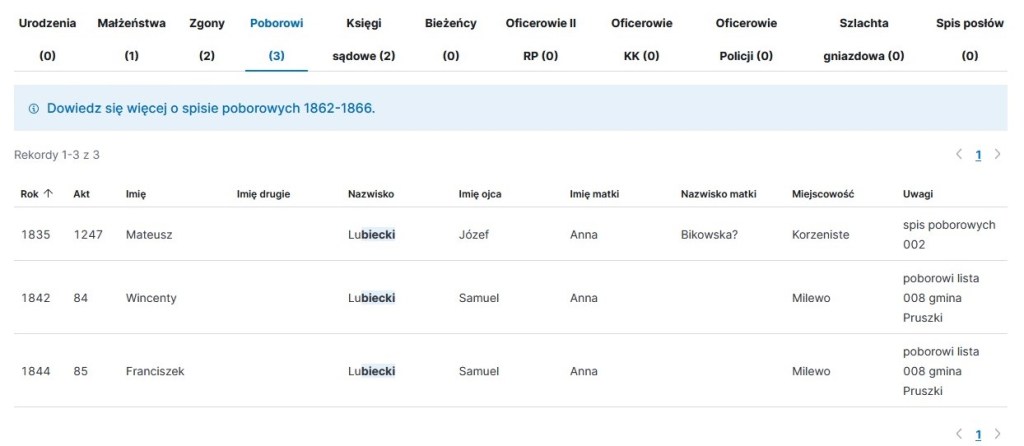
The results provide the entry number in the document, name and surname, date of the event, names and surnames of parents and spouses, place of residence and parish.
For the list of conscripts, this is the name and surname, place of residence, wife’s name or status designation (bachelor, widower), and the commune for which the census was made.
However, this is where another problem becomes apparent.
As far as parishes are concerned, the project is inconsistently extended beyond the declared Podlasie and Masovia.
You can get information from Wielkopolska, Kujawy, Warmia, Silesia, but it is very selective. To find out which places we are talking about, you have to use the second search engine.
https://katalog.projektpodlasie.pl/
This is the Catalog of Record Books.
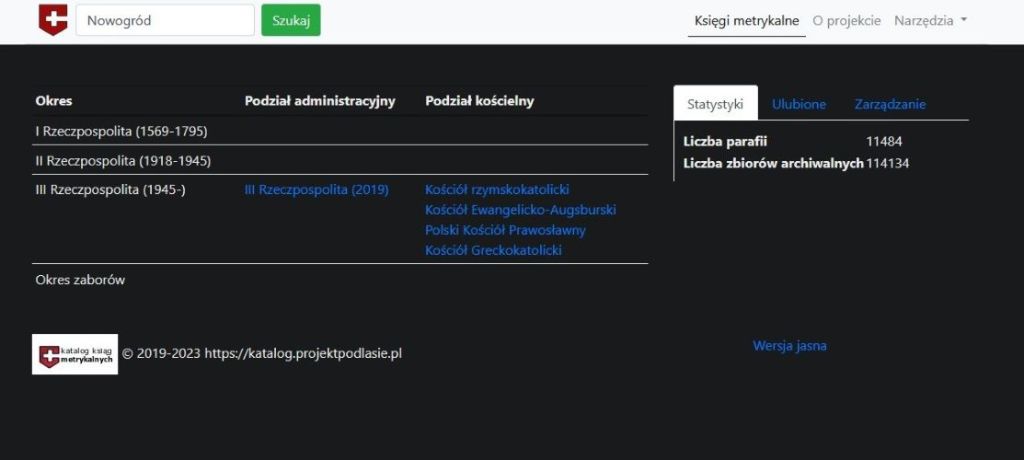
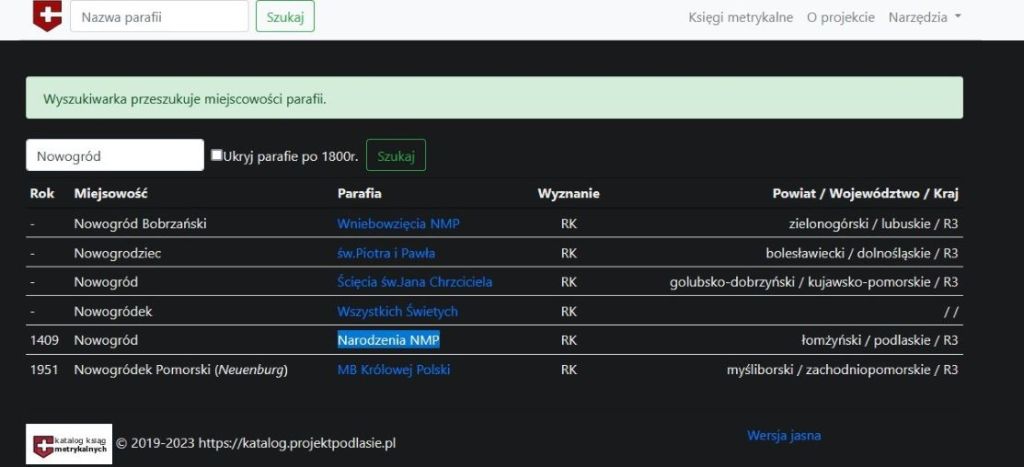
After entering it and writing the location of the parish in the search box on the upper left corner, you will get a list of all parishes in places with this name throughout Poland. From the oldest to the youngest, erected even in the last decade.
The list of results includes the year of establishment of the parish (or it is missing if it is unknown), the name of the town, the name of the parish, the type of denomination – but there is only the Roman Catholic denomination – RK, as well as the district, voivodeship and country.
After clicking on the parish name highlighted in blue, we go to the catalog of books of this parish.
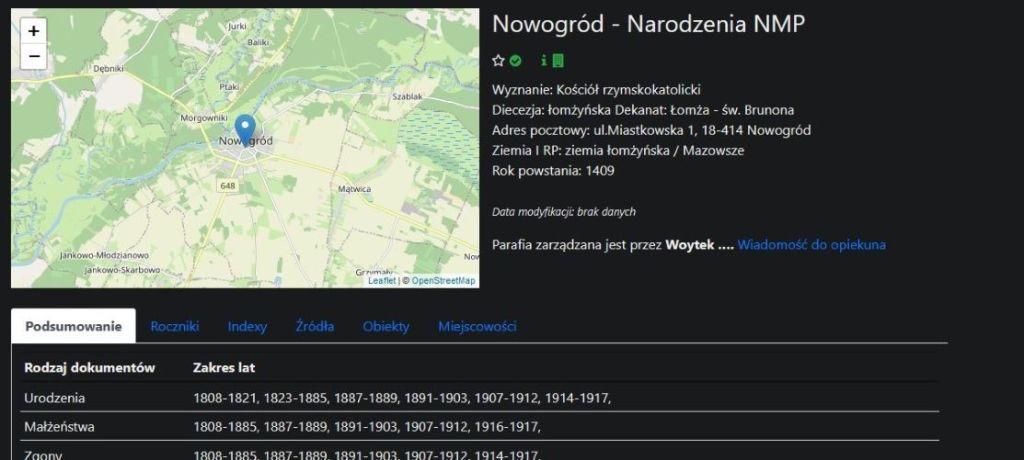
On the center page is Google map with the given place marked is displayed, along with full address details.
There are 6 tabs below: Summary, Annals, Indexes, Sources, Objects, Places.
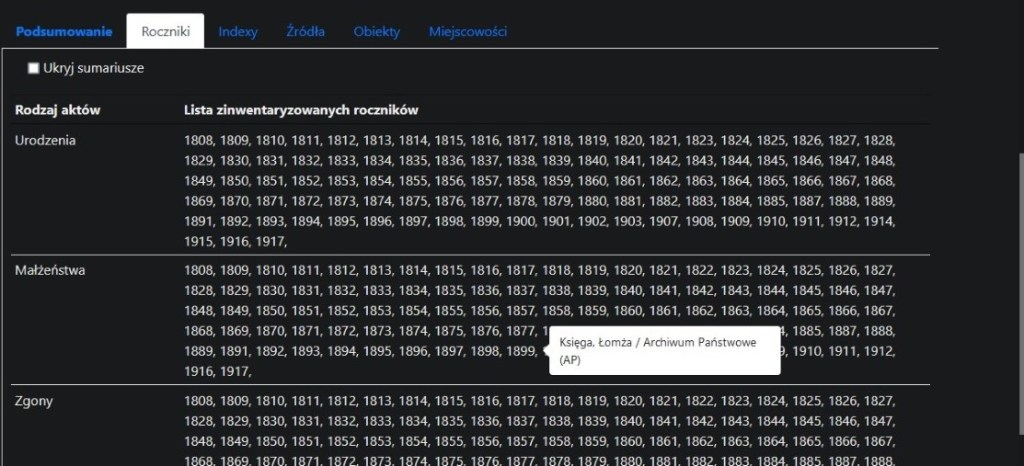
In the second one – Annals, all existing books appear, divided into Births/Marriages/Deaths and possibly Annexes or Vouchers (documents needed to enter into a marriage).
When you hover the cursor over a specific year, the location where a given book is stored is displayed.
The third tab (Indexes) contains the years that were indexed by Projekt Podlasie. And again, an unpleasant surprise – the link below does not redirect to the parish index, but to a page informing about the error.

The Projekt Podlasie database is large, although searching is a bit complicated. However, for north-eastern Poland it is certainly useful, complementing (though also duplicating) Geneteka’s indexes.
- Refugees who in 1915, during World War I, were asked or even forced to leave the western provinces of the Russian Empire and move deeper into Russia. There were about 3 million people, mainly of the Orthodox faith. ↩︎
If you are interested in finding ancestors in Poland, subscribe to this blog. Then you will not miss information that is useful to you.
 ASK LIDIA