
In an earlier entry about searching for ancestors in the Lubelskie Voivodeship
How to search in Eastern Poland? Lubelskie Voivodeship.
I discussed the Lubgens database, which contains primarily indexes from church record books. This is, of course, the easiest way to find information about an ancestor. However, as is the case with this type of source, not all books have been preserved, not all years of entries are complete, not all entries are legible.
Therefore, we should be happy about the initiative of the Lublin Genealogical Society, which, on the occasion of the 100th anniversary of Poland regaining independence, developed indexes of conscripts and recruits called up to the tsarist army in the 19th and 20th centuries in the Lublin region, Podlasie and the Siedlce region.

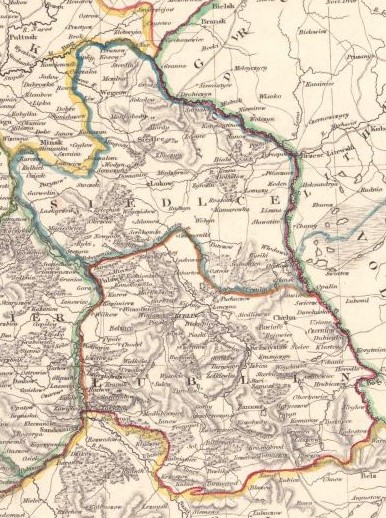
The expansion beyond the area of the Lublin Voivodeship was necessary because the Lublin Governorate, in various years, apart from the former Polish Lublin Voivodeship (from the times of the First Polish Republic), also included the Podlasie Governorate (in the years 1837-1844).
It is worth emphasizing that creating such a database required much more work than indexing record books. Researchers had to search various military files collected in a very large file set of the Lublin Governorate Office for Military Duty, kept in the State Archives in Lublin.
Recruit’s database
As the whole website is run only in Polish, I am presenting it briefly.
After entering any phrase in the search engine, entries in which this phrase is included are displayed. It can be an independent word, e.g. Burak.
As you can see in the presentation, results are displayed for the surname Burakowski and for records where there is a wife with her maiden name Burak, as well as a record where the wife’s maiden name contains the entire phrase (Cyburakówna).
The search engine is very fast, the results are filtered after entering the first letter.
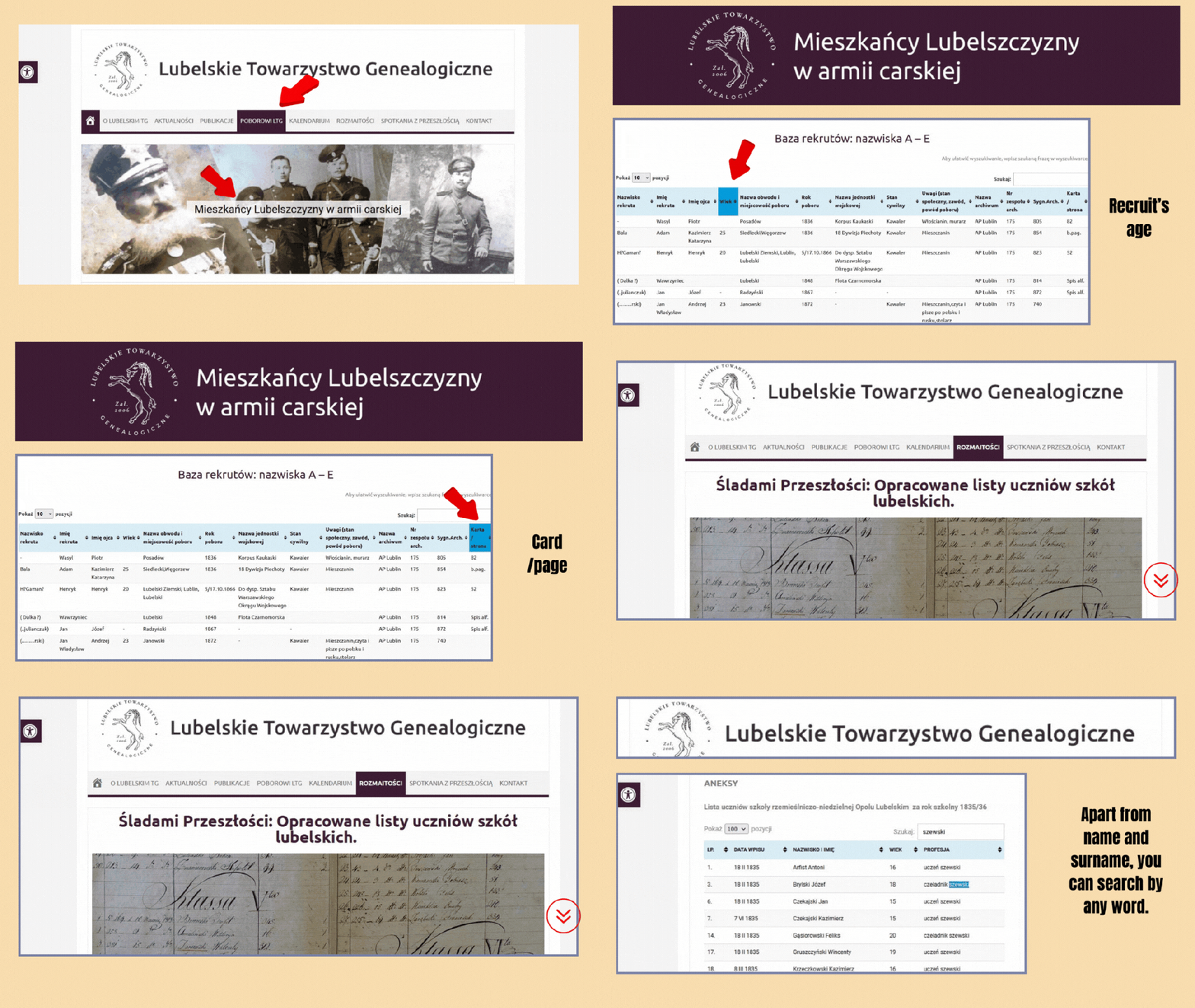
As you can see, the amount of information contained is quite large: in addition to the usual identification data such as name, surname, father’s name or age of the conscript, in the “marital status” column, a married man had his wife’s name and maiden name and the names and ages of his children entered.In turn in the “comments” column one can find out whether a given person could read, what profession he performed or whether the right to buy out from military service was exercised.
The last three columns are data allowing the identification of the document. If you know the archive, the number of the archival group, the archival reference number of the unit and the number of the page on which the entry is located, you can contact the archive and order a scan of the document.
List of cases
The database was additionally expanded to include a list of cases pending before the Government Office for Military Duties in Lublin in the years 1874-1915. This is less data than in the Recruit Database – the name and surname of the person filing the case (not necessarily the soldier himself, often a family member), the date of entry and a record of what the case was about, so its information scope is much more modest. If a record seems interesting, it would be necessary to check the case files in the archives, for which it would be necessary to hire a researcher.
School index.
The third project worth attention is school student indexes.
For now, there are only a few of these schools, so this is information for the future. However, the Society intends to systematically add new student lists, so it is worth checking from time to time what new things have been added. The scope of information is diverse, which is why (at least so far) they have not been unified and each school is a separate search engine. Some schools have censuses dating back to the 17th century, providing a rare opportunity to reach generations far back.
Summary.
It is certainly worth familiarizing yourself with the contents of the recruit database of the Lublin Governorate.
It has a large territorial scope, covers almost 100 years and provides a lot of interesting information. Although there is no redirection to scans, archival numbers are provided so that you can order a specific document directly from the appropriate state archive.
 ASK LIDIA